If you are deploying ₹2.5 Crores or more today, you need to understand exactly what engineering mechanics drive this loyalty. We are doing a structural teardown of the "Sobha Engineering Machine," decoding the manufacturing model that Harvard Business School actually studied, analyzing the 36-acre Sobha City masterplan in Thanisandra, and exposing the hard due-diligence trade-offs you must accept before paying the "Sobha Premium."
The "Backward Integration" Monopoly
To understand why Sobha is functionally untouchable in finishing quality, you have to look at how 95% of the real estate industry operates. Most developers are essentially just asset managers. They buy land, outsource the architecture to a design firm, hire a third-party contractor to pour concrete, and outsource the carpentry, plumbing, and glazing to local vendors.
When five different outsourced vendors touch a single wall, you get handoff gaps, misaligned windows, plumbing leaks, and hollow tiles.
Sobha operates entirely differently. They use a Backward-Integrated Construction model. This approach is so rare in the global real estate sector that it was formally documented in a 2018 Harvard Business School case study (Case #219-034: Sobha Group Real Estate: Backward Integration for Quality).
Instead of outsourcing, Sobha owns the entire supply chain:
- In-House Manufacturing: They operate their own concrete product plants producing high-strength blocks, alongside one of India's largest factories for interiors and woodwork, and dedicated metal works for specialized aluminum window glazing.
- No External Consultants: Sobha runs dedicated in-house teams covering architecture, structural engineering, mechanical, electrical, and plumbing (MEP).
When the company that draws the architectural blueprint is the exact same company that manufactures the concrete blocks and builds the wooden door frames, you eliminate dimensional errors. That is the secret to their flawless finish.
The Proof of Concept: Sobha City, Thanisandra
Let’s look at how this manufacturing precision scales into a mega-township. Sobha City in Thanisandra is a 36-acre Mediterranean-themed integrated township featuring 65% open spaces, interconnected green corridors, and a massive clubhouse.
But the real magic of Sobha City isn't just the 3 BHK layout or the koi ponds. It is structural aging.
If you inspect a 10-year-old unit in Sobha City today, you won't find the standard Bengaluru seepage issues or concrete spalling. Because Sobha manufactures its own structural concrete components and strictly enforces mechanical tolerances, their towers possess superior structural durability. They do not age like standard outsourced buildings.
The Resale Liquidity Engine
This engineering obsession directly dictates the financial reality of the secondary market. Why do Sobha resale values skyrocket while neighboring projects stagnate? It comes down to depreciation optics.
When a high-net-worth buyer walks into a standard resale apartment, they mentally deduct ₹15 to ₹20 Lakhs for civil repairs, bathroom overhauls, and fixing warped doors. When they walk into a 10-year-old Sobha resale, the visual depreciation is virtually zero. The skirting boards are intact, the factory-finished doors sit perfectly in their frames, and the exterior paint hasn't flaked off the concrete.
10-Year Secondary Market Trajectory & Maintenance Savings
+84.2% Net Resale Surge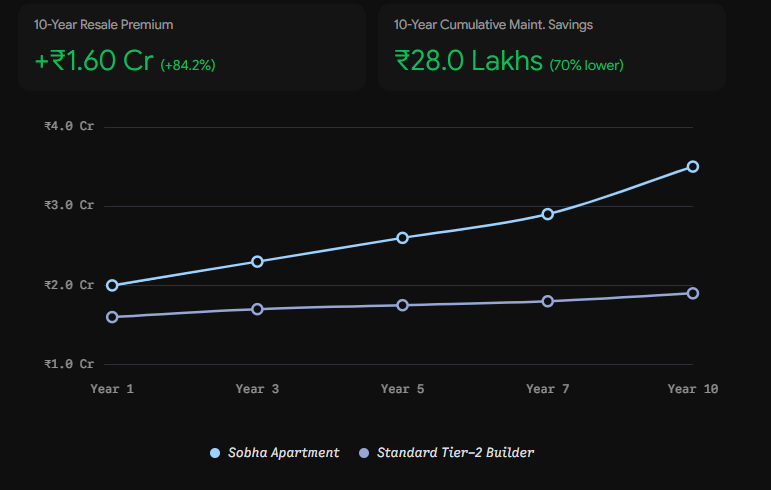
Comparative empirical audit: Sobha Apartment vs Standard Tier-2 Builder over a 10-year holding timeline, proving an incremental +₹1.60 Cr capital premium and ₹28.0 Lakhs in cumulative maintenance savings.
Look at the current secondary market data for Thanisandra: Standard premium apartments in the micro-market (like Bhartiya Nikoo Homes Phase 2) are currently trading between ₹11,250 to ₹12,000 per sq.ft. Meanwhile, 10-year-old Sobha City apartments are commanding ₹14,450 to ₹16,800+ per sq.ft.
Key insight: When supply is artificially restricted by resident loyalty, and demand is driven by buyers who specifically filter their search for "Sobha properties only," the resale premium naturally commands 20% to 30% above the micro-market average.
The Hard Objections (Due Diligence)
However, this level of engineering control comes with three very specific trade-offs that you must accept before buying in.
You are paying for that backward-integrated factory precision upfront. Sobha launch prices are routinely positioned at the absolute top tier of the micro-market. If you are an aggressive investor looking for a cheap entry-ticket to flip in 18 months, this is the wrong developer for you. This is a strict capital-preservation play.
Because Sobha's floor plans are hyper-optimized for structural rigidity, they rely heavily on reinforced concrete shear walls rather than standard brick masonry. If your dream is to buy a 3 BHK, completely knock down the internal walls, and create a massive open-plan living room, you will hit a hard structural roadblock. What you see on the floor plan is permanent.
Sobha communities age well because their property management rules are famously rigid. If you want to enclose your balcony with non-standard grills, hang laundry over the exterior railings, or make chaotic external modifications, the estate management will block you. You are trading individual customization for strict communal aesthetic preservation.
The Final Verdict
People do not become Sobha loyalists because of slick marketing campaigns. They stay because the product fundamentally works exactly the way it was promised on day one.
By owning their own timber factories, concrete plants, and architectural firms, Sobha eliminated the third-party contractor risk that plagues Indian real estate. You pay a heavy premium to get through the gates, but in return, you get an asset that refuses to degrade.