Digital tokens flash on giant screens. Priority queue numbers pass 1,500 for a 400-unit inventory. By Day 2 of the official allotment, the entire phase is declared sold out.
Most people dismiss this as pure pre-sales theatre and manufactured FOMO. But then you look at the secondary market: five years later, when those towers are handed over, that exact same project commands an immediate 30% to 50% resale premium over almost every rival building on the same road.
Here is a complete architectural and financial teardown of the Prestige Machine. We are decoding how a retail tailoring business from 1986 built an unshakeable institutional moat, why their existing communities generate fanatical customer loyalty, the exact math behind their secondary market dominance, and the hard due-diligence realities you must accept before signing that EOI cheque.
The EOI Machine & The 48-Hour Sellout
To understand why Prestige commands this market, you have to look at how their pre-sales funnel actually operates. While developers across India spend months pitching, discounting, and offering subvention schemes just to get 40% of a project booked, Prestige routinely clears out entire residential phases in 48 to 72 hours.
It isn't just slick marketing; it is an engineered liquidity machine built on three layers:
- The Loyalty Priority Pass: Long before a public hoarding goes up, Prestige’s internal customer base—over 50,000 existing homeowners and repeat high-net-worth investors—gets private early-allocation windows.
- The Tiered Token Structure: Prestige doesn't just collect a random token. They collect banked, non-negotiable booking deposits tied to strict priority numbers. If you hesitate on Day 1, your unit is instantly handed to the next token in the queue.
- Price Progression Certainty: Prestige has conditioned the Bengaluru market to understand one ironclad rule: The price you see on Day 1 will never be offered again. In subsequent phases, rates systematically increase by ₹500 to ₹1,000 per square foot. That built-in escalation creates immediate financial safety and locked-in equity for Day 1 buyers.
The Legacy Moat: From Commercial to Retail
How did Prestige build this level of blind trust? It wasn't built through residential brochures; it was built through massive commercial and institutional scale.
Founded in 1986 by Razack Sattar and led by Irfan Razack, Prestige began in high-end retail but quickly pivoted into commercial spaces. When multinational tech giants flooded into Bengaluru during the IT boom, Prestige built the Grade-A office campuses that housed them: Prestige Tech Park, Prestige Cessna Business Park, and Prestige Shantiniketan.
Then came retail. In 2004, they fundamentally changed Bengaluru’s social culture with The Forum Mall on Hosur Road in Koramangala—the first destination mall the city had ever seen. A few years later, they developed UB City, establishing the absolute pinnacle of luxury retail and Grade-A commercial office space in South India.
Why does this matter to an apartment buyer?
Mid-tier builders rely almost entirely on customer installment advances to keep cement moving. If residential sales slow down, their construction stops. Prestige backed its residential pipeline with massive, recurring rental annuities from millions of square feet of leased IT parks and malls. Even when real estate cycles turned cold, their balance sheet kept tower cranes operating. That absolute delivery certainty is what converted initial buyers into lifetime brand evangelists.
The Built Community Reality
A slick pre-sales engine only works once if the delivered product fails. The reason Prestige launches sell out on Day 1 is because buyers have walked through the communities they delivered ten years ago.
- The True Integrated Ecosystem: Projects like Prestige Shantiniketan in Whitefield or Prestige Lakeside Habitat in Varthur proved that Prestige doesn't just build apartments; they build self-sufficient towns. Lakeside Habitat spans 102 acres with over 80 acres of open landscaped grounds and an artificial lake. Shantiniketan integrated an IT park, residential towers, and a retail mall inside a single perimeter.
- Clubhouse Scale & Sports Infrastructure: While smaller builders treat clubhouses as an afterthought stuffed into a dark basement, Prestige engineers 40,000 to 70,000 sq.ft standalone lifestyle hubs. From Olympic-length lap pools to full-size football arenas, their communities are designed for active families.
- Prestige Property Management Services (PPMS): The biggest failure point in Indian real estate is what happens 5 years after handover—elevators break down, paint peels, and STPs fail. Through PPMS, Prestige maintains long-term operational control over their flagship developments. The landscaping stays manicured, security remains institutional, and maintenance reserves are professionally audited.
The Resale Engine & Secondary Market Liquidity
Why do investors treat Prestige like a high-yield blue-chip stock? It comes down to Secondary Market Liquidity.
In real estate, an asset is only as good as your ability to exit it. If you own an apartment in an unbranded standalone building, finding a buyer who can secure bank approvals, clear title diligence, and agree on valuation can take 9 to 12 months.
A Prestige apartment in an established micro-market is a highly liquid commodity. Tier-1 banks clear title approvals on their files in days. On the rental side, expatriates, corporate leaders, and senior IT directors actively pay a 15% to 25% rental markup to live inside a Prestige township because of the safety, community maintenance, and children’s sports amenities. High rental demand drives steady investor demand, creating a pricing floor that prevents resale values from dropping during market corrections.
5-Year Holding Period ROI: Prestige Mega-Township vs Standard Mid-Tier Builder
Audit: 62.0% vs 41.5% Total ROI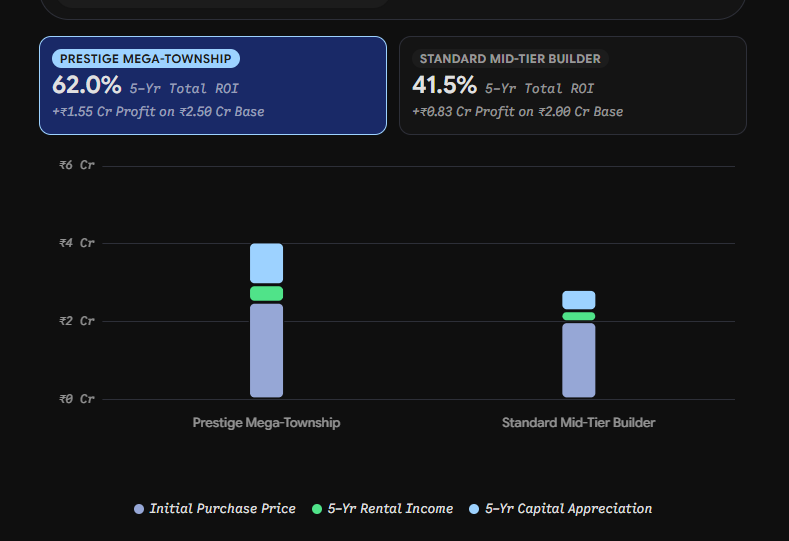
Empirical secondary market returns: Prestige Mega-Township delivers +₹1.55 Cr net profit on a ₹2.50 Cr base (62.0% Total ROI), outperforming standard mid-tier alternatives through compounded rental markups and brand liquidity upon exit.
To model exactly how Prestige's brand premium and rental markups offset their higher initial launch prices compared to standard builders, explore this interactive ROI simulator:
Key insight: You pay a heavy brand premium at launch, but the backend liquidity and 15-25% rental markups consistently generate a higher net ROI upon exit compared to "cheaper" unbranded alternatives.
The 3 Hard Objections (Due Diligence)
Before you join the next EOI rush, you must address the three hard due-diligence realities:
Prestige is acutely aware of its brand power. Their launch rates are rarely "bargains." You are often paying today for the infrastructure of 3 years from now. If you are looking for an immediate deep-discount flip, you won't find it here. You must hold for the full construction cycle to unlock capital growth.
Prestige builds big. When you buy into a 2,000-to-4,000-unit mega-community, you are buying into a high-density vertical township. Common amenities, swimming pools, and access gates will see heavy traffic on weekends. If your definition of luxury is a quiet, 40-unit boutique building, a large Prestige masterplan will feel overwhelming.
Because Prestige communities feature grand multi-tier clubhouses, expansive entrance portals, and double-height lobbies, their loading factors generally sit around 28% to 33%. You must calculate your purchase on the net usable RERA carpet area, not just the quoted super built-up number.
The Final Verdict
Prestige’s 48-hour sellouts are not an accident, and they aren't just clever social media hype. They are the cumulative result of 40 years of commercial delivery, aggressive township engineering, and a secondary market that consistently rewards buyers who hold for the long term.
When you buy Prestige, you aren't just buying four walls; you are buying the liquidity of their brand name and the peace of mind that the project will actually be delivered and maintained.