Hundreds of investors in the comments called it the "flawless Bengaluru playbook."
At first glance, it sounds clean, disciplined, and logical. But when you pull out the actual builder cost sheets, run the multi-year tax math, and stress-test their picks against 2026 ground realities, half of their surface-level assumptions collapse.
People in the thread made two massive mistakes: first, they calculated Day-One rental yields and completely ignored the multi-crore compounding engine of holding prime IT corridor real estate over a seven-year cycle. Second, they assumed you can walk into North Bengaluru with ₹1 Crore and easily pick up prime Grade-A developer land.
Here is the unfiltered truth. We are putting Reddit's favorite property strategy under the microscope to examine what this anonymous investor got dead right, the dangerous blind spots that could cost you lakhs, and how to mathematically allocate a ₹3 Crore corpus to maximize both cash flow and capital appreciation.
What Reddit Got Dead Right (The "Brand Name" Trap)
Let’s give credit where it’s due. The Reddit author made one statement that every investor in Bengaluru needs tattooed on their forehead:
"The biggest mistake investors make in 2026 is buying a famous builder project at peak launch pricing and assuming appreciation will automatically happen."
That is 100% accurate. We see buyers every single week paying ₹16,000 to ₹17,000 per square foot for an under-construction apartment purely because of the Tier-1 logo on the brochure, while identical, high-quality ready-to-move units on the exact same road trade at ₹12,500.
When you buy at the absolute peak of a developer's pre-sales hype, you hand your first four years of capital appreciation straight to the builder's marketing department. A brand name gives you legal title safety and delivery certainty, but it does not protect you from overpaying. If your entry price is bloated, your investment is dead money for years. Their warning on entry pricing is spot on.
The Whitefield Rental Reality Check: Day-1 Yield vs. 7-Year Total ROI
Now, let's look at the post's first core allocation: buying into mega-launches like Prestige Raintree Park in Varthur or Sobha Neopolis in Panathur for "Cash Flow and Liquidity." The Reddit thread argues that 3 BHK rentals here command ₹60,000 to ₹90,000 per month, making it an unshakeable cash-flow engine.
Here is what the Reddit thread initially missed: The Day-One Gross Yield Compression.
- If you buy a premium 3 BHK in a project like Raintree Park or Neopolis today, your all-in acquisition cost after GST, floor rise, parking, and registration sits between ₹3.6 Crores and ₹3.9 Crores.
- If that apartment rents for ₹80,000 a month in Year 1, your annual gross rental income is ₹9.6 Lakhs.
- Divide ₹9.6 Lakhs by an outflow of ₹3.75 Crores, and your Year-1 gross rental yield is barely 2.5%.
If you evaluate this purely as a short-term cash-flow play, a 2.5% gross yield barely beats inflation and barely offsets maintenance and property taxes. But let’s not make the amateur mistake of judging an institutional real estate asset by Day-One rental yield alone.
Real estate in an active, multinational tech corridor does not behave like a static fixed deposit; it is a multi-year compounding engine. Look at what happens when you hold an asset like this over a 5 to 7-year horizon:
- Rental Escalation: In Whitefield and the Outer Ring Road, corporate demand and low Grade-A vacancy rates drive standard 7% to 10% annual rental escalations. That ₹80,000 starting rent climbs past ₹1,25,000 to ₹1,30,000 a month by Year 7, generating over ₹80 Lakhs to ₹85 Lakhs in cumulative rental cash flow.
- Capital Compounding: Even if you assume a conservative 8% to 9% annual capital appreciation—well below speculative land surges—your ₹3.75 Crore asset grows to roughly ₹6.8 Crores by Year 7.
When you combine ₹3 Crores+ in capital appreciation with ₹85 Lakhs of collected rent, your total wealth generated crosses ₹3.8 Crores on that original asset. You do not buy Whitefield for high Day-One cash yield. You buy it for Total ROI, downside protection, zero vacancy risk, and unmatched secondary market liquidity.
The Mid-Tier Arbitrage & The Balanced Hebbal Play
Where the Reddit post becomes genuinely sharp is its analysis of mid-tier developers alongside the Hebbal and Thanisandra corridor.
The author points out that Tier-2 or Grade-B+ developers in Panathur or Whitefield can actually outperform the blue-chip giants on pure return on investment. Why? Because you strip away the 20% to 25% "brand tax" at entry.
If you acquire a high-spec Mivan 3 BHK for ₹1.8 Crores instead of ₹2.6 Crores, your tenant rent might only drop by 10%, but your Day-One rental yield jumps past 4%. For investors prioritizing immediate cash-on-cash returns, that entry arbitrage is massive.
Their analysis of Hebbal and Thanisandra is also rock solid. Because Manyata Tech Park anchors over 150,000 high-earning tech employees, and the corridor connects directly to the international airport via NH-44, established communities like Embassy Lake Terraces, Karle Zenith, and Bhartiya City Nikoo Homes operate at near-100% occupancy year-round. With typical gross yields sitting comfortably around 4% to 5% alongside steady capital appreciation, the Manyata belt remains Bengaluru’s most reliable "balanced" investment corridor.
The Devanahalli Land Reality (The 10-Year Infrastructure Bet)
Finally, let’s look at their aggressive 10-year bet: parking ₹1 Crore into land in Devanahalli, Bagalur, or the Aerospace Park. The thesis claims that the Foxconn mega-plant, the Aerospace SEZ, and the Blue Line Metro will turn North Bengaluru land into a massive wealth multiplier.
The macro thesis is 100% correct: Land along an expanding infrastructure spine compounds faster than vertical apartments because land has zero structural depreciation.
However, Reddit missed the ground reality of the entry ticket:
- If you want a standard 1,500 sq.ft plot inside a gated community from a Tier-1 developer like Prestige Marigold in central Devanahalli, your all-in landing cost is no longer ₹1 Crore—it sits between ₹1.3 Crores and ₹1.6 Crores.
- If your hard budget is strictly ₹1 Crore to ₹1.1 Crores, you are looking at compact 1,200 sq.ft plots in newly expanding peripheral nodes—like Sattva’s new plotted launch in Doddaballapura right off the STRR, which starts at ₹1.03 Crores.
If you take the plotted route, do not compromise on developer pedigree just to hit a ₹70 Lakh price point. Unorganized layouts with unpaved roads and uncertain title deeds will trap your capital. Buy Grade-A plotted developments with underground cabling, guaranteed water grids, and direct arterial access, and commit to holding them debt-free for a full 7-to-10-year infrastructure cycle.
Portfolio ROI Simulator (7-Year): Land Capital vs Apartment Capital vs Accumulated Rent
Result: ₹6.38 Cr (+112.7% Return)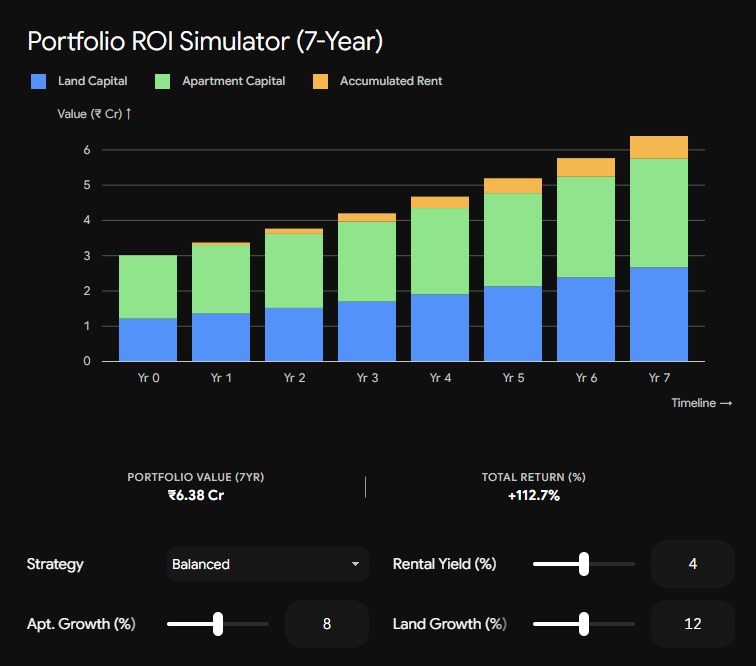
Empirical 7-year multi-asset allocation model: Balanced strategy deploying ₹1.8 Cr apartment capital (8% growth, 4% rental yield) alongside ₹1.2 Cr land capital (12% growth) reaches ₹6.38 Cr portfolio value (+112.7% total return).
To see exactly how these mathematical realities play out over a 7-year holding period, explore this interactive allocation simulator:
Key insight: A pure land portfolio (Option C) offers the highest theoretical peak value due to superior compounding rates and zero depreciation, but the balanced portfolio (Option A) provides vital downside protection through steady, escalating rental cash flow.
The ₹3 Crore Portfolio Blueprint: 3 Real-World Allocation Scenarios
So, if you hold a liquid ₹3 Crore corpus to deploy in Bengaluru today purely as an investor, how do you mathematically structure the capital? Here are the three verified blueprints:
Option A: The Balanced Growth & Cash Flow Portfolio (The Smart Play)
- ₹1.8 to ₹2.0 Crores: Acquire a high-efficiency 3 BHK in a proven rental corridor like Panathur, Whitefield, or Thanisandra from a strong Grade-A/B+ developer (like Sumadhura or Bhartiya City) to lock in an immediate 4% yield and strong corporate tenant demand.
- ₹1.0 to ₹1.2 Crores: Deploy the remaining capital into an institutional gated plot along the STRR or Airport corridor (such as Sattva Thippapura or an early-phase Devanahalli layout) for long-term, tax-efficient land compounding.
Option B: The Pure Rental & Liquidity Portfolio (The Cash Flow Play)
- Split the ₹3 Crores into two ₹1.5 Crore 2.5 or 3 BHK apartments in high-demand rental belts like Thanisandra, Kogilu, or Budigere Cross.
- This provides instant tenant diversification, dual rental checks every month, and easier resale flexibility since liquidating a ₹1.5 Crore unit is significantly faster than selling a single ₹3 Crore asset.
Option C: The Aggressive 10-Year Wealth Multiplier (The High-Beta Play)
- Deploy the entire ₹3 Crore corpus across two Grade-A plotted land parcels directly along the STRR or Aerospace Park growth spine.
- You generate zero rental cash flow for the first five years, but you avoid tenant management entirely, pay zero building maintenance depreciation, and capture the full upside of North Bengaluru's industrial transformation.
The Final Verdict
The viral Reddit strategy gave the market a fantastic starting conversation, but real investing requires separating marketing headlines from hard balance sheets.
Do not get blinded by famous builder logos at inflated launch rates, and never dismiss an IT corridor investment purely because its Year-One rental yield looks modest. Real estate wealth is created when you control your entry price, understand the multi-year compounding engine, and strictly match your holding period to the infrastructure roadmap.