Something very aggressive is happening on Sarjapur Road right now.
In the last few months, Mana Developers signed Bollywood icon Ranbir Kapoor as their national brand ambassador. But behind the scenes, they made an even bigger structural move: they quietly acquired top-level executive marketing and operational talent directly from the Prestige Group.
When a historically mid-tier builder starts spending massive capital on Bollywood superstars and surrounding themselves with Tier-1 corporate executives, they are sending a very specific signal to the market. They are trying to cross the boundary from being a "good local builder" to becoming a Tier-1 institutional giant.
Welcome to the unvarnished brand audit of Mana Developers. Today, we are decoding why they are transforming their leadership, looking at the biophilic architecture that actually makes their projects unique, and most importantly, pulling up the raw online customer reviews to see if the actual living experience matches the Ranbir Kapoor marketing budget.
The Prestige Poach: The Business Shift
If you look at the residential map of Sarjapur Road and Carmelaram, Mana practically owns massive stretches of it. Look at their delivery pipeline: Mana Tropicale, Mana Foresta, Mana Capitol, and their massive upcoming launches like Mana Dale and Mana The Right Life.
For years, Mana had a very specific identity: they built beautiful, green, nature-heavy projects for the upper-middle class. But as property prices in Bengaluru exploded, buyers on Sarjapur Road stopped looking for ₹1 Crore homes. They started hunting for ₹2.5 to ₹3.5 Crore ultra-luxury estates.
When you ask a senior tech executive to pay ₹3 Crores, a beautiful garden is not enough. They demand Tier-1 execution: flawless facility management, zero timeline delays, and institutional CRM processes.
That is exactly why Mana brought in executive leadership from industry giants like Prestige. They are injecting Tier-1 corporate discipline—the kind of rigid, clockwork operations that the Prestige machine is famous for—into Mana’s existing massive land bank. The Ranbir Kapoor endorsement is just the shiny front cover designed to signal to banks, NRI investors, and high-net-worth buyers that Mana now has the deep pockets and the corporate structure to compete directly with Sobha, Puravankara, and Prestige themselves.
The Product: What Actually Makes Mana Different?
Marketing hype aside, what are you actually buying when you write a cheque to this developer?
If you strip away the branding, Mana’s true unique selling proposition (USP) is Biophilic Architecture.
Most builders in Bengaluru buy a piece of land, bulldoze every single tree on it, pour massive concrete slabs, and then plant small decorative palm trees near the clubhouse to call it "green." Mana does the exact opposite.
Tree-First Masterplans
In Mana Tropicale and Dale, they physically map out 50-year-old mahogany and oak trees before designing towers. Roads and courtyards curve around ancient canopies.
True Vertical Forests
In Mana Foresta, balcony columns are structurally reinforced with heavy cantilever engineering to sustain living trees and computerized drip irrigation on the 10th floor.
Breathable Microclimates
Large bio-retention ponds and dense green buffers physically drop ambient temperatures by 2°C to 3°C compared to external concrete heat islands.
In projects like Mana Tropicale and Mana Dale, they physically map out the 50-year-old mahogany and oak trees on the land before they design the tower placements. They build the driveways and the courtyards around the existing forest. In Mana Foresta, they introduced actual vertical forests on the balconies, structurally engineering the tower columns to hold the weight of mature trees and irrigation systems on the 10th floor.
If you are an end-user who hates the feeling of living inside a sterile, glass-and-concrete IT park, Mana’s masterplans feel radically different. They feel like actual breathable resorts.
The Reality Check: Online Reviews vs. On-Ground Communities
But a great architectural masterplan is only as good as its execution. What happens when you look at what real buyers are saying online?
If you scrape the Reddit forums, NoBroker reviews, and Google ratings for projects like Mana Capitol or The Right Life, you will see a very distinct, documented split in customer sentiment based entirely on the lifecycle of the project.
The Complaints
The Advocates
Mana Resident Sentiment Lifecycle
Sentiment shift from early handover teething to long-term biophilic loyalty.
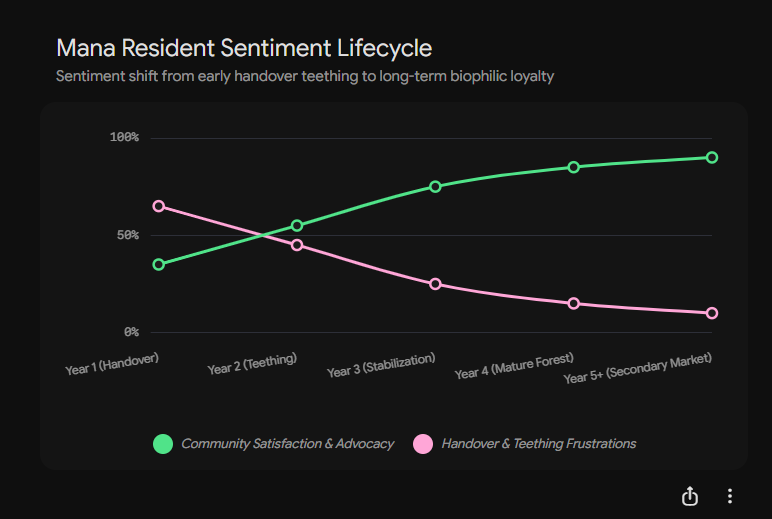
Evaluating a biophilic developer during the first year of handover gives a skewed, highly negative picture due to civil finishing delays. The true premium of their architecture only unlocks in Years 3 and 4 when the landscape fully integrates.
The 3 Hard Due-Diligence Objections
Before buying into Mana's new ultra-luxury rebrand, you must accept three hard trade-offs:
-
1. The Execution Speed Penalty
You cannot build a vertical forest or navigate heavy tree-retention zones using the same rapid Mivan-formwork speed as a standard concrete box. Expect construction cycles to be slower, and build a buffer into your expected possession timeline.
-
2. Higher CAM Charges (Maintenance)
Maintaining massive 40-lakh-litre bio ponds, vertical balcony irrigation systems, and extensive botanical gardens requires specialized landscaping crews. Your monthly Common Area Maintenance (CAM) charges will structurally run higher than a standard apartment complex.
-
3. The Infrastructure Boundary
Mana builds beautiful oases, but the minute you step outside the gate in Carmelaram or Gattahalli, you are hit with the chaotic reality of Sarjapur Road's infrastructure deficit. You are buying a private bubble, not a publicly manicured neighborhood.
The Final Verdict
Mana is currently in a massive corporate transition phase. By bringing in Prestige’s operational talent and putting Ranbir Kapoor on the billboards, they are aggressively pushing into the Tier-1 luxury space.
If you are an investor looking for a rapid 12-month flip, this might not be your play; the early-stage teething delays will hurt your exit liquidity. But if you are an end-user family looking to anchor on Sarjapur Road, and you want a developer that actually respects the natural topography instead of just pouring concrete over it, Mana's upcoming launches are backed by much stronger corporate machinery today than they were five years ago.
Related High-Conviction Sarjapur & East Bengaluru Developments
Compare Mana’s biophilic flagship against Tier-1 integrated township alternatives and boutique communities along Sarjapur and Varthur Road.
 📍 Sarjapur - Varthur Belt
From ₹1.15 Cr*
📍 Sarjapur - Varthur Belt
From ₹1.15 Cr*
Mana Skanda (The Right Life)
- ✓ Flagship Biophilic: 100+ acres designed with expansive preserved tree clusters.
- ✓ School Corridor: Minutes from Greenwood High, Inventure Academy & TISB.
- ✓ Prestige DNA: Operations structured by former Tier-1 executive teams.
- ✓ RERA Approved: PRM/KA/RERA/1251/446/PR/231224/007328.
 📍 Varthur / Whitefield
From ₹1.89 Cr*
📍 Varthur / Whitefield
From ₹1.89 Cr*
Evergreen @ Raintree Park
- ✓ Tier-1 Fortress: 107-acre integrated masterplan with on-site Tech Forest IT park.
- ✓ 25:75 Scheme Available: Pay 25% today, 75% on possession in late 2028.
- ✓ Direct Peer Comparison: Tested benchmark for buyers comparing Mana’s ₹3 Cr bracket.
- ✓ RERA Registered: PRM/KA/RERA/1251/446/PR/270824/006981.
 📍 Sarjapur Road Belt
From ₹1.40 Cr*
📍 Sarjapur Road Belt
From ₹1.40 Cr*
The Amberstone Sarjapur
- ✓ Commute Efficiency: Direct access to Carmelaram and ORR Bellandur tech hubs.
- ✓ Forensic Reality Check: Verified water sustainability, title, and RERA compliance.
- ✓ Rental Yield: 4.7%–5.3% rental absorption from Wipro and Cisco professionals.
- ✓ RERA Compliant: Fully audited regulatory and possession schedule.