
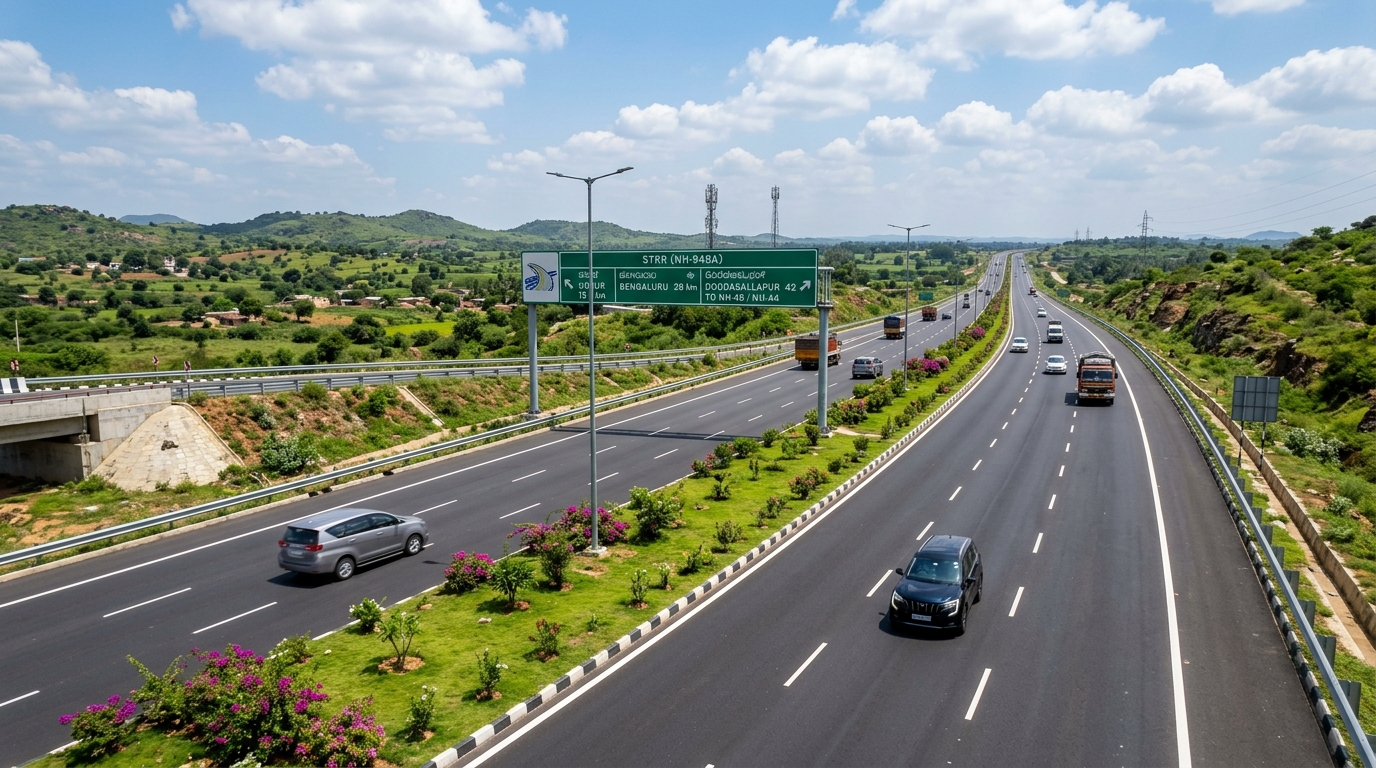
How the 280-km NH-948A Satellite Town Ring Road creates India's first purpose-built outer economic ring, analyzing the four macro investment belts, operational timelines, and investor playbook.
Every monumental leap in Bengaluru’s real estate has been triggered by a singular infrastructure pivot. It was Electronic City that ignited Hosur Road. It was the Outer Ring Road that birthed Bellandur. It was the International Airport that dragged the city’s center of gravity north.
But if you are analyzing the current market data and tracking absorption rates, the next massive wave of capital won’t be deployed inside the city limits. For channel partners, wealth managers, and early-entry investors, the game has shifted.
The most critical project setting the foundation for the next 20 years of wealth creation is the Satellite Town Ring Road (STRR). This is not just a highway. It is a 280-km engineered perimeter that completely restructures how Bengaluru will operate, forcing the city to grow outward rather than upward.
What STRR (NH-948A) Actually Is
Officially designated as NH-948A, the STRR is a 280-km access-controlled expressway featuring 4 to 6 lanes and a massive 90-meter right-of-way. But here is the structural genius of the project: it does not connect the city; it connects the towns around the city.
By linking Dobbspet, Doddaballapura, Devanahalli, Hoskote, Malur, Sarjapur, Attibele, Anekal, Kanakapura, Ramanagara, and Magadi in a continuous loop, STRR creates India’s first purpose-built outer economic ring. It is a massive conveyor belt for logistics, heavy industries, and self-sustaining satellite townships.
The Systems-Level Impact: Why This Changes the Math
For professionals structuring portfolios and advising on land banking, STRR fundamentally alters Bengaluru's real estate dynamics in four specific ways:
- The Freight Bypass System: National freight and highway movement will no longer touch the inner city. The chronic pressure on ORR, Hebbal, and Tumkur Road will drop dramatically, making peripheral logistics parks exponentially more valuable.
- Activating Satellite Economies: Towns like Hoskote and Attibele that historically fed off Bengaluru's core will become autonomous economic hubs.
- The Job-to-Housing Logic: The data never lies—industries follow highways, warehousing follows industries, and jobs follow both. Once employment anchors are set, residential demand transitions from speculative to highly predictable.
- A Hard Boundary for Sprawl: For the first time, Bengaluru’s expansion is not chaotic. STRR draws a definitive boundary, giving investors a clear map of where the outer limits of the city will solidify over the next decade.
The Four Macro Belts: Where Channel Partners Should Focus
When decoding the STRR corridor for clients, it is essential to segment the ring into four distinct economic belts, as they each carry different risk-to-reward ratios.
| STRR Zone | The Route | The Investment Logic |
|---|---|---|
| 🔵 Belt 1: The Northern Arc | Doddaballapura → Devanahalli → Hoskote | The fastest-moving sector. Anchored by KIADB Aerospace Park and the Airport, this is the prime zone for immediate institutional and residential capital. |
| 🟢 Belt 2: The Eastern Arc | Hoskote → Malur → Narasapura | The manufacturing backbone. High demand for industrial land, warehousing, and blue-collar housing. |
| 🟡 Belt 3: The Southern Arc | Sarjapur → Attibele → Anekal → Kanakapura | The dual-demand corridor. One end captures the IT spillover from Sarjapur, while the Kanakapura edge targets premium second-home and plotted development buyers. Read our corridor analysis: Unwrapping Kanakapura Road & Green Line Metro. |
| 🔴 Belt 4: The Western Arc | Ramanagara → Bidadi → Magadi → Nelamangala | The heavy industrial powerhouse. Ideal for long-term land banking and industrial asset deployment. |
Prestige KIADB Phase 2 & Devanahalli Villas
High-appreciation logistics & airport expressway corridor. 400m from Global Financial GCC hub.
Ground Reality: Timelines & Operational Bottlenecks
Let’s cut through the generic brochure promises and look at the operational reality.
Currently, an 80-km stretch from Dobbspet to Hoskote is already functional. While the entire corridor has an aggressive target for late 2025–2027, practical execution faces hurdles. Land acquisition complexities in the southern and western arcs, combined with environmental clearance friction near the Bannerghatta eco-sensitive zones, have historically slowed progress.
However, STRR is moving forward, albeit unevenly. For early investors, this phased progress is precisely where the arbitrage opportunity exists.
The Investor Playbook: Structuring the Pitch
When advising clients or building a sales strategy around STRR, use these targeted positioning rules:
Interchange Land Yields the Highest Premium: Pockets where STRR intersects with existing national highways will experience the first and sharpest spike in land valuations.
Plots Outpace Apartments Early On: Because plotted developments require fewer civic approvals and less ground-up infrastructure, they are the safest early-entry asset class along the corridor.
Industrial Belts Guarantee Early Rental Demand: Target areas near the Eastern and Western arcs for clients seeking stable, predictable tenant pools driven by engineers, factory managers, and logistics operators.
SOBHA Sacred Grove – Phase 2 (Chikka Tirupathi)
400m from STRR Eastern Arc. 26.14-acre lakeside masterplan, 99 villa plots from ₹86.39L*, IUSTUS Sports Academy & free maintenance till 2033.
FAQ: Decoding STRR for the Market
What is the current operational status of the STRR?
As of mid-2026, the 80-km northern arc connecting Dobbspet, Doddaballapura, and Hoskote is fully operational. Construction across the southern and western phases is advancing, with the entire 280-km loop targeting completion in the coming years.
How will STRR affect existing real estate within Bengaluru?
By diverting heavy freight traffic away from the city center and the Outer Ring Road, the STRR will heavily reduce congestion in existing IT corridors, indirectly boosting the livability and sustained value of central hubs.
Where is the safest early investment along the STRR?
The Northern Arc (Doddaballapura to Hoskote) currently holds the lowest risk due to existing operational roads, proximity to the international airport, and heavy concentration of active KIADB industrial parks.
The Prestige KIADB Phase 2 at Sulibele (Devanahalli STRR)
📍 KIADB Phase-2, Sulibele Road, STRR - Devanahalli • 2 Mins to STRR • 15 Mins to Kempegowda International Airport
Position capital directly at the intersection of Belt 1's highest institutional growth. Prestige Group's new pre-launch masterplan spans ~12 acres with ~1,800 premium residences across 9 high-rise towers (3B+GF+24UF). Starting at ₹ 70 Lakhs* with early-bird EOI advantages.
Kalyani Living Tree — 20:80 Payment Plan, KIADB Aerospace Park
25-acre integrated township inside the Aerospace Park. Pay just 20% now and 80% only on possession. 2 & 3 BHK from ₹1.16 Cr*. On-site cricket ground, 70%+ open space.