While both are massive orbital highways designed to decongest the city, they serve entirely different economic purposes and attract completely different buyer profiles. One is designed to move software engineers between tech parks, while the other is built to move freight trucks between states.
Here is a direct, unvarnished comparison between the PRR and the STRR. We are breaking down their actual 2026 execution timelines, mapping their specific alignments, and detailing exactly which one you should bet on depending on whether you are buying a ₹2 Crore apartment or a 5-acre land parcel.
The PRR (Bengaluru Business Corridor): The Urban Pressure Valve
Let's start with the Peripheral Ring Road (PRR), which the government has officially rebranded as the Bengaluru Business Corridor (BBC).
This is essentially the new Outer Ring Road. It is a roughly 73-kilometer, access-controlled expressway designed to cut through the northern and eastern parts of Bengaluru. It connects Tumakuru Road to Hosur Road, slicing directly through Ballari Road and Old Madras Road.
The Transit Purpose:
The PRR is built for the urban commuter and the IT professional. Its primary job is to absorb the massive traffic spillover from the saturated Outer Ring Road (ORR) and connect established tech hubs directly to the Kempegowda International Airport.
After decades of delays, the PRR has finally moved into active implementation:
- The project successfully secured its environmental clearance in April 2026.
- Construction is split into packages, and Package 1 (a 20 km stretch from Madavara to Ballari Road) has been awarded, with preparatory work and contractor mobilization actively underway.
- The government is currently targeting a full commercial completion around 2029.
The Real Estate Play:
This is your premium residential and commercial IT play. If you are buying apartments or villas in Yelahanka, Hennur, Greater Whitefield, or Sarjapur Road, the PRR is your macro-catalyst. Once operational, land adjacent to the PRR will immediately transition into high-density tech parks and luxury high-rises.
The STRR: The Heavy Logistics Bypass
The Satellite Town Ring Road (STRR) is a beast of a different nature. It is a massive, 288-kilometer orbital highway that creates a regional ring around the extreme periphery of the city.
The Transit Purpose:
The STRR is a dedicated freight and logistics bypass. Its primary job is to catch heavy commercial trucks traveling from Mumbai or Chennai and route them around Bengaluru, keeping them completely out of the city center.
Unlike the PRR, major sections of the STRR are already a physical reality:
- An 80-kilometer stretch from Dobbaspete to Hoskote is fully operational and has been tolled since 2024.
- The National Highways Authority of India (NHAI) is pushing aggressively on the remaining packages and expects to have roughly 144 kilometers of the highway officially open by November 2026.
The Real Estate Play:
The STRR does not create IT parks; it creates manufacturing SEZs and massive warehousing hubs. Your play here is land and logistics. If you are deploying patient capital into large commercial plots, warehousing, or affordable plotted developments aimed at factory management, you invest in STRR nodes like Doddaballapura, Devanahalli, and Hoskote.
10-Year Investment Return Model
PRR Residential vs. STRR Land-Bank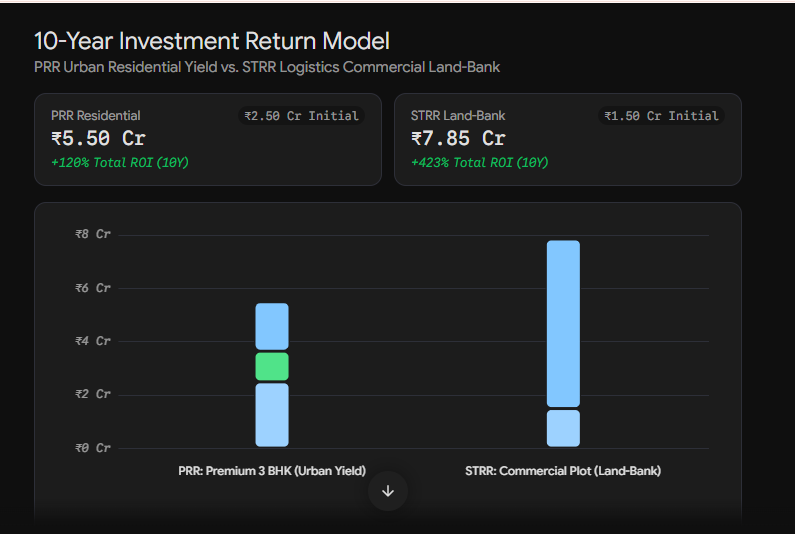
The Matchmaker Decision Tree
Both of these ring roads will create immense wealth, but you have to match your capital to the right road. A truck bypass will not help your IT tenant get to work, and a city highway cannot accommodate a multi-acre logistics hub.
Bet on the PRR (Bengaluru Business Corridor). If you are buying a premium 3 BHK apartment for immediate rental yield, or a luxury villa for your family, bet on the PRR. Focus on locations like Hennur, Yelahanka, and Sarjapur. You want to be close to the future tech parks and the Metro connectivity that will inevitably follow the PRR alignment.
Bet on the STRR. If you are a High-Net-Worth Individual looking to land-bank, or an investor seeking multi-bagger returns on plotted developments over a 7-to-10-year horizon, follow the STRR. Focus on the industrial gravity of Doddaballapura or the logistics explosion happening along the Devanahalli-Hoskote corridor.
Are you positioning your portfolio for the immediate urban growth of the PRR, or are you locking in land for the long-term industrial boom of the STRR?